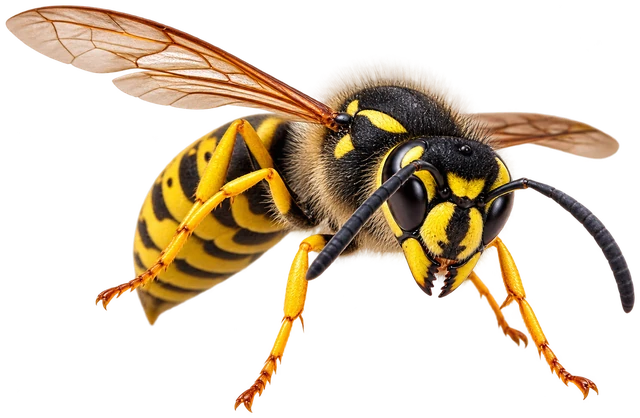
Yellowjackets (Vespula)
Yellow and black, 10-15 mm. Often nest in the ground, wall cavities, and utility voids. The most common around summer patio tables.
A wasp nest near living areas poses a real risk of multiple stings. PROTECH neutralizes nests, visible or hidden — up high, in the ground, or inside the structure — with the right equipment and method.
Wasps trapped inside a wall can chew their way through and emerge inside the house. The intervention must follow the right order.
Quebec's social wasps build their nests in a variety of spots: eaves, trees, the ground, wall cavities. The species and location determine the method of intervention.
Yellow and black, 10-15 mm. Often nest in the ground, wall cavities, and utility voids. The most common around summer patio tables.
Black and white, stockier build. Builds the large grey paper nests hanging from trees and eaves.
Wasps chew wood fibres to build their nest — a new colony every year, never reused.
Founded in spring by a single queen, a nest can reach thousands of individuals by late summer.
Near the nest, wasps attack as a group, and each wasp can sting multiple times.
Colonies die off with the first frost; only new queens overwinter. Still, an active nest in summer can't wait until fall if it threatens occupants.


A nest far from living areas can sometimes be left alone until the end of the season. But a nest near a doorway, a deck, a window, a balcony, or inside a wall calls for intervention: the risk of multiple stings is real, and especially serious for people with allergies (anaphylactic shock).
Nests in wall cavities are the trickiest: blocking the entrance without neutralizing the colony can push wasps to chew through the drywall and emerge inside the house.
Protective equipment, appropriate products, and the right timing: destroying a nest isn't something to improvise.
Identifying the species, the nest's exact location, and its access points.
Treating the nest with proper protective equipment and products, at the optimal time.
When possible and relevant, removing the nest; otherwise, confirming it's fully inactive.
Recommendations to reduce the risk of future nesting: sealing, soffit screens, managing attractants.
It's risky: without full protective gear, multiple stings can happen within seconds, and nests high up or inside walls carry extra dangers. For a small, very accessible new nest, caution may be workable; for everything else, leave it to a professional.
Nests posing an immediate risk are treated as a priority — often the same day or the next, depending on the area and season.
No, nests are never reused. However, a favourable spot (an open soffit, an accessible cavity) can attract a new queen the following spring — hence our prevention recommendations.
Bees are fuzzy, stocky, and only sting as a last resort; they're also essential pollinators. If a bee swarm settles on your property, relocation by a beekeeper is preferred over extermination. Send us a photo if you're unsure.
Don't wait until the end of summer — nests grow bigger every week. Fast, safe intervention.