Quebec's largest ant
6 to 25 mm depending on caste. Winged individuals (reproductives) that swarm in spring are often mistaken for termites — which are absent from residential Quebec.
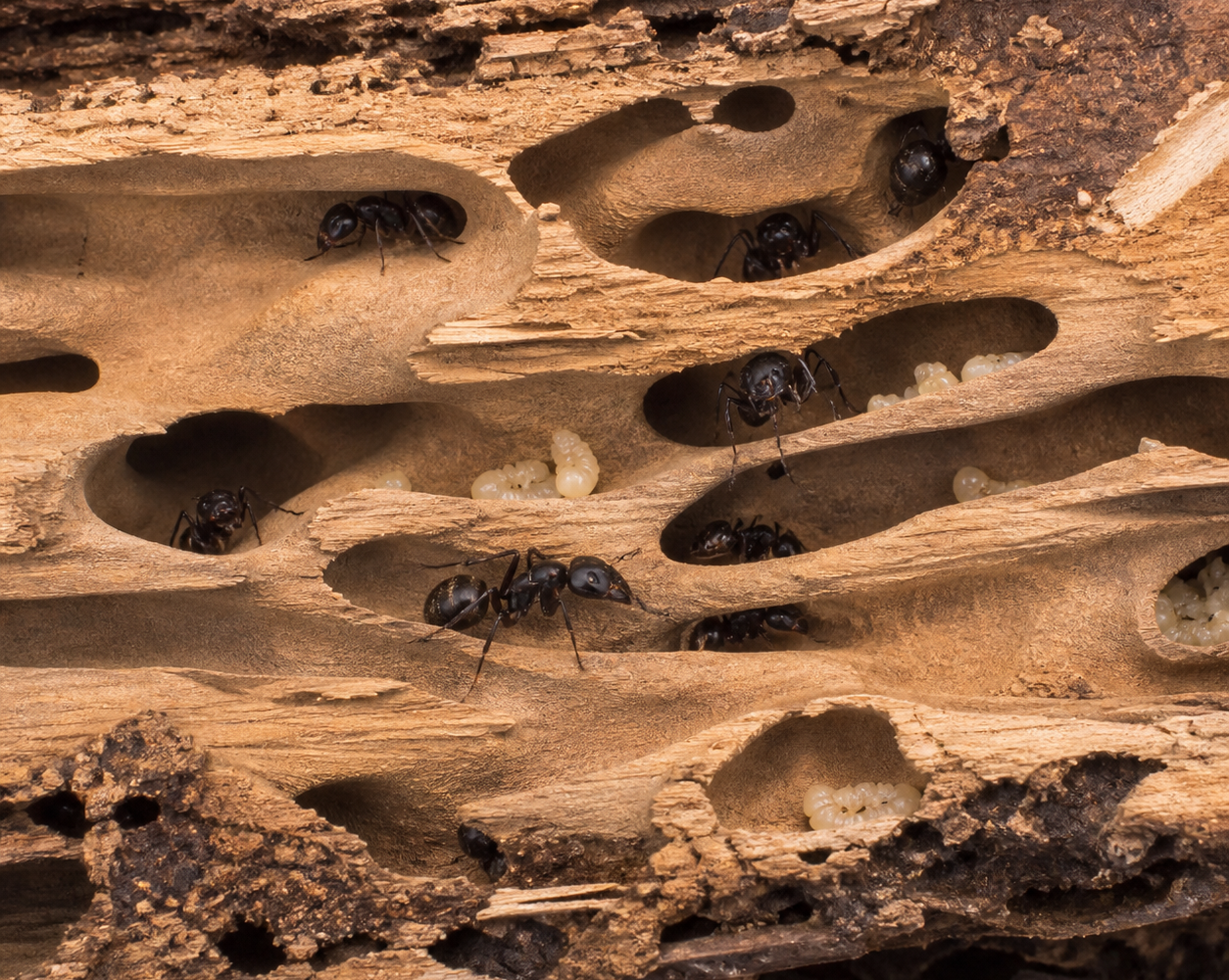
Carpenter ants don't eat wood — they hollow it out to house their colony. Year after year, their tunnels can weaken structural elements. Early intervention limits the damage.
Joists, window sills, roof framing: areas with past water damage are its favourite targets.
A large black ant — sometimes black and red — with an evenly rounded thorax. Workers vary greatly in size within the same colony, which is a helpful identification clue.
6 to 25 mm depending on caste. Winged individuals (reproductives) that swarm in spring are often mistaken for termites — which are absent from residential Quebec.
It excavates smooth, clean galleries in wood softened by moisture, ejecting fine sawdust mixed with insect debris.
The main nest is often outdoors (a stump, tree, or dead wood). Satellite nests settle inside the building, in dry wood or insulation.
Workers mostly come out at dusk. Nighttime observation helps track their paths back to the nest.
In quiet moments, you may hear a faint crackling in the walls: the colony at work.
Roofs, windows, bathrooms, sills: any wood that's had water infiltration becomes a potential target.


Contrary to popular belief, carpenter ants don't devour wood — they hollow it out to establish their colony. The result is the same: tunnels that gradually weaken joists, lintels, studs, and roof framing.
A mature colony can number in the thousands and have been established for years before it's detected. That's why any sign — sawdust, recurring large ants, spring swarming — deserves a prompt professional inspection.
The goal: reach the colony — main nest and satellite nests — not just the visible workers.
Looking for tunnels, sawdust, trails, and moisture sources, including the outdoor perimeter.
Finding the main nest (often outdoors) and satellite nests within the structure.
Applying professional products in tunnels and nesting areas, with baits as needed.
Recommendations for fixing moisture issues, removing nearby dead wood, and a follow-up visit.
Their damage progresses more slowly than termites' (which are absent from Quebec homes), but a colony established for years can seriously weaken structural elements. Early intervention makes all the difference.
The main nest is often outdoors — a stump, dead tree, or woodpile. Workers can travel dozens of metres and establish a satellite nest in any building, especially if there's been water infiltration.
Killing the visible workers doesn't solve anything: the colony keeps digging. Without locating the nests and treating them directly, the problem persists and the damage progresses.
Fix moisture problems, replace damaged wood, keep firewood away from the building, trim branches touching the roof, and seal cracks. We provide precise recommendations after treatment.
Every season counts: the sooner the nest is treated, the less damage it causes. Free inspection and quote.